
E / I
Extraversion / Introversion
Whether attention and energy are more often directed outward toward people and activity, or inward toward thoughts and reflection.
About 5 minutes · No sign-up
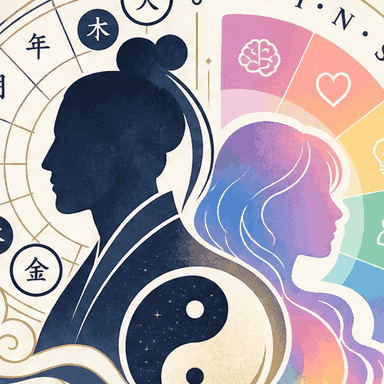
We combine our in-house 16-type assessment with a Four Pillars birth-chart reading to explore your personality, decision logic, relationships, career and the environment in which you may thrive.
Seeing both perspectives together can also suggest longer-term lifestyle changes, helping you work to your strengths rather than constantly working against your weaknesses.
Your collection starts here
Your answers and birth chart create a personal astrology card — the first card in your collection.
Share it with a friend. After they take the assessment, you each receive a card, and your friend gets 50% off their first detailed reading.
Basic analysis free · Full AI report ₩2,900
Tax included · One-time payment
Sample result
This is what you get
ESTJ2 points of disagreement · Outward vs yin
You answered as someone who spends energy outward (E 61%), but your chart is 100% yin — energy that gathers inward. Bright with people, and then needing an unusually long time to recover.
The Myers-Briggs Type Indicator (MBTI) is a framework that describes personality preferences through 16 types, built from four pairs. Each pair is a spectrum rather than a box.
Read Me uses an independently written, in-house 16-type assessment. It is not an official MBTI assessment and is not affiliated with or endorsed by The Myers-Briggs Company.
E / I
Whether attention and energy are more often directed outward toward people and activity, or inward toward thoughts and reflection.
N / S
Whether you tend to notice patterns and possibilities, or concrete facts and direct experience.
T / F
Whether decisions tend to begin with consistent logic and criteria, or values and their effect on people.
J / P
Whether you tend to prefer plans and closure, or flexibility and keeping options open.
No type is better, right or wrong. The useful question is how your preferences support you and where they may create friction.
Four Pillars is an East Asian astrology tradition that reads the year, month, day and hour of birth as four pillars. We use it as a language for self-reflection, not as guaranteed fact or a fixed prediction.
The chart balances five elements. In astrology, each is associated with a different style of energy:
Wood
growth, direction and initiative
Metal
structure, standards and boundaries
Fire
expression, warmth and momentum
Earth
stability, care and practical support
Water
insight, adaptability and depth
The heavenly stem of the day pillar is called the Day Master. It acts as the chart’s reference point: the other elements and relationships are interpreted in relation to it.
Each element also has a Yin or Yang expression. Yang is often read as more active, visible and direct; Yin as more receptive, internal and gradual. Neither is better, and every chart contains a relationship between the two.
The Ten Gods are ten symbolic relationships between the Day Master and the chart’s other energies. Korean romanisations are grouped here by theme:
Self
Wealth
Authority
Resource
Output
No ads
No interstitials, no pop-ups
No auto-billing
A single payment, not a subscription
No sign-up
We never ask for your email or phone
No waiting around
Your report opens 1–3 minutes after payment
Clear your cookies or switch devices and your result cannot be reopened. Link a Kakao account and you can recover it anywhere.
The only thing Kakao sends us is a member number. We never request your email, profile, or phone number.
You can keep using everything without saving.